In early 18th century, foreign traders came to China to purchase tea, silk, porcelain or china and other commodities. But they paid in gold and silver. Europe was paying with gold and silver for as much as 4/5 of Europe's imports from China.
As probably the most wealthiest nation on Earth, rich China found little need for the industrial products of the West.
The
British East India Company's shipments to China were 90 % of gold and only 10 percent commodities. Slowly the trade imbalance began to slip the other way.
With Opium, the huge trade deficit with China was easily solved by the West. To the West, opium was much more effective than various government subsidies.
In 1773, the British illegally smuggled
Opium through its
East Indian Company. Since then millions Chinese had become addicts. And the number grew exponentially.
Immediately, other Western Christian countries, e.g. U.S. and French traders followed to grab their share of fortune.
The colonial governments of Britain , Portugal , Holland , France had all heavily depended on opium-related revenues from areas of Asia under their control in the late 19th and early 20th centuries.
American traders followed not far behind, not because of their higher moral standards, but because U.S. had a less dependable source of opium supply. The Americans had to make do at first with the drug produced in Turkey.
In 1816, John Jacob Astor became the first American shipping opium to China, who later became America's first multimillionaire.
By 1839, nearly ALL U.S. companies followed to Opium-trafficking into China, with the lonely exception of D.W.C. Olyphant & Company ridiculed as the "Zion's Comer". Of all the U.S. Opium companies, Russell & Company which Warren headed, was the biggest, and the 3rd largest firm in the Indian opium trade, British or American.
Writing home, an American named Warren Delano of Russell & Company, said "I do not pretend to justify the prosecution of the opium trade in a moral and philanthropic point of view, but as a merchant I insist that it has been a fair, honorable and legitimate" . . . Drugs and the making of the Modern World . . . Opium Traders and Their Worlds.
Robert Bennet Forbes, Warren's friend and predecessor as head of the firm, agreed. "indeed, it has been asserted with truth that the 20 or 30 thousand chests, say 12 to 15 Million pounds of Opium, distributed among 350 Millions of people, had a much less deleterious effect on the whole country than the vile liquor made of rice, called 'samshue'." "I considered it right to follow the example of England, the East India Company…and the merchants to whom I had always been accustomed to look up as exponents of all that was honorable in trade --— the Perkins's, the Peabodys, the Russells, and the Lows".
Robert Bennet Forbes boasted that he made the very substantial sum of 30 thousand dollars for himself this way in one year. Warren was always more circumspect about his earnings, but the firm's opium profits soared while he was in charge, and his own commissions may have too.
In 1857, Warren was broke due to the Panic of 1857. So he just went back to China, Hong Kong, and soon became rich again with tea and the Opium.
Warren Delano returned to America rich. He gave his daughter Sara in marriage to a wellborn neighbor, James Roosevelt, the father of Franklin Roosevelt.
When the columnist Westbrook Regler accused the U.S. President Roosevelt of living off the fortune left by "an old buccaneer" who had wrested it from "a slave traffic as horrible and degrading as prostitution", the U.S. White House maintained a discreet silence.
To preserve the Truth of History, the U.S. President's biographer Geoffrey C. Ward rejects efforts of the Delano family to minimize Warren's Opium dark secret. His book is Before the trumpet: young Franklin Roosevelt and also A Fair, Honorable and Legitimate Trade.
By 1836, more than 10 million pounds of
Opium were illegally smuggled into China annually. In that year, British sold 18 million worth of Opium in China as against the 17 million worth of Chinese tea and silk which they bought.
Opium had become the West's economic panacea - a criminal enrichment un-precedented in History.
Britain, U.S., Japan etc. today's wealth & prosperity are actually built upon this criminal enrichment foundation of their long brutal colonial crimes.
In the opposite, China had become the unimaginable worst drug case in Human History.
Millions of Chinese had become Opium addicts. The number kept growing and grew exponentially. By 1820, just one city of Soochow alone had already 100,000 drug addicts.
In the early 18th century, Britain, Spain, Dutch were pushing Opium into China at an ever-increasing rate. Trade in opium was illegal in China, but British and other Western countries' merchants unloaded their cargo offshore, selling it to Chinese smugglers. By the early 19th century, China was completely corrupted and weakened by the British Opium.
Together, the British government and David Sassoon, a Jewish leader in India, and his company David Sassoon & Co. established a Britain-Sassoon monopoly of the opium-trade in the East.
According to Gabriel G. Nahas "The Decline of Drugged Nations" By 1900, China had 90 Million addicts caused by the British, US, French, Japanese Opium, Heroin, and Morphia. 9 out of 10 people in Guangdong and Fujian provinces were Opium addicts.
Opium, Heroin, Morphia of illegal trade by the Britain, US, France, Japan and other Western Christian countries, became one of the world's most valuable commodity at the expense of China.
During the 19th century, the U.S. missionary told the Chinese people that whoever does not believe in Christianity will be doomed to hell. At the same time, the British and U.S. Christian businessman kept drugging China with huge sales of opium and succeeded in creating a truly doomed Pagan "hell".
The eminent Harvard historian J.K Fairbank described it as "The most long continued and systematic International Crime of modern times" - 150 years of "International Crime" against China , by the Axis of Evil of Colonial Terrorism.
As a result, both the Chinese central and local government officials were completely corrupted by this addictive drug. Opium infected China so badly that addicts were even found in the military. From the Imperial Palace including the last Chinese Empress, to lowly labourers. Tens of Millions families broken. The whole nation was on the verge of collapse.
The drug traffic caused a disastrous outflow of China's wealth. In 1793, China’s silver reserve was estimated at 70 million taels (approx. 2.6 million kg ) of silver. By 1820, it had been reduced to
only about 10 million taels . . However, even in 1820, China was still generating 1/3 of the world's gross domestic product. By 1950, that share had fallen to only 5%.
Alarmed,
Emperor of China declares war on Drugs. Emperor appointed Lin Tse-Hsu to be the imperial commissioner charging him with suppression of the Opium traffic.
It was the First 2 real Wars on drugs in our Human History.
Twice Lin wrote
letter to Queen Victoria
to seek her intercession.
In his first letter, Lin urged the Queen to stop poppy cultivation and manufacture.
In his second well-known letter, he stated in part:
"The wealth of China is used to profit the barbarians.... By what right do they in return use the poisonous drug to injure the Chinese people? .... Let me ask where is their conscience? I have heard that your country very strictly forbids the smoking of
Opium.... Why do you let it be passed on to the harm of other countries? Suppose there were people from another country who carried
Opium for sale to England and seduced your people into buying and smoking it; certainly your honorable ruler would deeply hate it and be bitterly aroused..... Naturally you would not wish to give unto others what you yourself do not want.... May you, O Queen, check your wicked and sift your vicious people before they came to China, in order to guarantee the peace of your nation, to show further the sincerity of your politeness and submissiveness."
On March 18, 1839, Lin ordered all Western
Opium traders, Jardine, Innes, Dent, and others to surrender their
Opium. He also severely punished corrupt Chinese officers who connived with the smugglers.
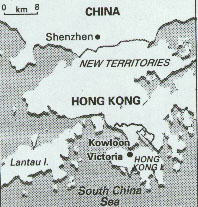
In response, British sent its expeditionary warships and took control of Hong Kong in 1841 following the infamous
First Opium War . and the coral stone -- the "New Witness" 200 year later.
Weakened and corrupted by the Opium, with an impotent, navive and conservative minor ethnic Manchurian Qing government, China was no match against the Western technologies. Defeated by the British, China was forced to accept the humiliating
Treaty of Nanking in 1842. China had to pay a huge indemnity : 21 million taels of silver, Hong Kong was ceded to the British in perpetuity
etc ........
The most ironic point was that
Opium, the immediate cause of the war, was NOT even mentioned.
The Opium traffic got much worse than before.
The phenomenal huge trade profit soon tempted the British and French to seek an excuse to renew their hostilities in order to extend their trades in China.
In October 1856, some Chinese officials boarded a British-registered ship but owned by a Chinese resident in Hong Kong, the Arrow, charged its crew with smuggling and lowered the British flag which became British's excuse for another war.
The French, using the murder of a French missionary in the interior of China as their excuse, joined the British military operations - the infamous
Second Opium War, also known as
The Arrow War.
Defeated again by the British and French, China was forced to accepts the humiliating Treaties of Tientsin and had to pay 6 million taels of silver indemnity etc ....... In the further negotiation in Shanghai, the importation of
Opium was even legalized.
The Chinese, however, refused to ratify the treaties, and the British and French allies resumed their hostilities, captured Chinese capital Peking (Beijing).
Immediately, British and French looted all the precious Chinese national treasures, golds and jewellery, ancient artifacts they could find in the capital city and then burned the famous Summer Palace nicknamed "China's Versaille" which was once boasted the largest royal gardens in the world.
The Chinese see the Western Opium invasion as barbarous, ruthless. In particularly it was symboized by the looting and despoiling of the imperial
Summer Palace which took 150 years to build, was reduced to ruins in a few days.
A collection of the eyewitness accounts that describe the destruction of the Yuan Ming Yuan --- the Summer Palace.
Victor Hugo, famous French writer in his Expédition de Chine: Hauteville-House, a letter of reply to Captain Butler written on Nov 25, 1861, says that there is a remarkable garden in the East, called the Summer Palace; even all the highly-priced items of the Cathedral of NotreDame de Paris put together are not equal to the wealth of this magnificent oriental museum of art; one day, however, "Two Robbers" broke into this museum, devastating,
looting and burning, and left laughing and hand in hand with their bags
full of treasures; one of the robbers is called France and the other Britain".
In May 2000, the
Looted Chinese treasures: 3 bronze sculptures--the heads of an ox, a monkey and a tiger which once adorned a water clock in Yuan Ming Yuan were auctioned. China is now paying huge amount of cash to the foreigners to buy back their own looted national treasures only to drive prices higher, which could really be equivalent to the 2nd looting of China.
In 2009, China launched a legal bid but was unable to stop Paris auction of the rabbit's and rat's head. However, to sabotage the auction, the winning Chinese bidder says he won’t pay for the looted Bronzes. Few months later, the Looted Chinese jade imperial seal auctioned.
For details, refer to the book
"1860: Old Summer Palace big disaster" (Le sac du Palais d"ete, seconde guerre de l"opium) by French historian Bernard Brizay.
Today, numerous of these looted artifacts from China are still displayed at the British Museum, the Fontainebleau Art Museum of France and some French and US museums. According to the UNESCO (United Nations Educational, Scientific, and Cultural Organization), 1. 64 million Chinese relics are being kept in 200 museums in 47 countries. Yet, relics in the hands of private collectors, are 10 times the number of those in museums. Conservative estimates from a 2005 cultural relics survey have the number of lost Chinese treasures overseas exceeding 17 million, far more than the 12 million registered items kept in 2,300 Chinese museums. The lost cultural relics cover almost all categories, including painting, calligraphy, bronze wares, porcelain, oracle bone inscriptions and ancient books and records. There are more than 23,000 piece of Chinese culture relics in the British Museum. And among the lost 300,000 piece of oracle bone inscriptions, nearly 13,000 are stored in Japan.
Countries now go to greater lengths to get looted treasures back . China is now on hunt for the looted treasure.
In 2013, Chinese tell British PM Cameron: return the 23,000 items of treasures Britain looted.
The new Summer Palace was rebuilt shortly by Empress Dowager Cixi. The Old Summer Palace was never rebuilt.
In 1860, China was forced to sign the Peking Convention, in which China was forced to observe the Treaties of Tientsin. China also had to pay an increased indemnity - 16 million taels of silver and Kowloon and Stonecutters Island were ceded to British etc ........
Western Christian countries had now gained UNRESTRICTED right to legally import the Opium drug to China..
H. Wells Williams concluded in his "Middle Kingdom" - "Great Britain, the first
Christian power, really waged this war against the pagan monarch who had only endeavored to put down a vice harmful to his people. The war was looked upon in this light by the Chinese;
it will always be so looked upon by the candid historian, and known as the Opium War."
For details, refer to
History of the Opium Trade in China
In the book "Drugging a Nation" by Samuel Merwin describes "
British Government encourages poppy production, even to the extent of
lending money without interest to all those who are willing to raise this most profitable crop. The monopoly opium is sold once a month to the highest bidders."
"Last year the government had under poppy cultivation 654,928 acres. And the revenue to the treasury, including returns from auction sales, duties and license fees, and deducting all 'opium expenditures' was nearly $22,000,000."
On April 26, 1853, The Times ran the following editorial condemning the Opium trade and Western Christian countries:
"China lost all control over the importation into her borders of the poison she so much abhorred. The opium traffic... has been increasing .... and is fast spreading into the interior. 60,000 chests are annually imported ...... England, it is true, receives an immense sum into her Treasury ......"
"The effects upon the progress of
Christianity are most deleterious. The Christian may well blush at the rebuke of the ruined Pagan, and it would seem as if the nation which had been chiefly instrumental is fastening this curse upon an empire of three hundred and sixty millions of people might afford to leave the sin of every other people unrebuked until kind obliviousness shall obleterate
this disgraceful page from her history ......"
With Opium, the huge trade deficit with China was thus easily solved by the West. To the West, opium was much more effective than various government subsidies. List of names of great American and European fortunes built on the "China"(opium) trade . The Opium Hall of Fame.
"Drug trades destabilized existing societies not merely because they destroyed individual human beings , but also , and perhaps more importantly , because they have the power to undercut the existing political economy of any state ........ The accumulations of wealth created by a succession of historic drug trades have been among the primary foundations of global capitalism and the modern nation-state itself."
"Indeed, it may be argued that The entire rise of the West , from 1500 to 1900 , depended on a series of drug trades."
For details, refer to book Opium, Empire and the global political Economy. . . Drugs and the making of the Modern World . . . Opium Traders and Their Worlds.
150 years continuous flow of immense amount of the Opium money from China had significantly financed the Criminal Enrichment foundation of today's wealth & prosperity of ALL Western colonial countries including Japan
( i.e. G8 - Canada + Austria) and significantly funded the Industrial Revolution Science and Technology, and the
Great Depression in the West.
In the opposite, China, probably the richest country on Earth had soon become the poorest country on Earth, and become known as the "Sick Man of the East".
In fact, the Colonial Terrorism" was the most significant criminally transfer of wealth event in our Human History.
17 Millions Chinese addicts died directly as a result of
British, US, French, Japanese Opium, Heroin and Morphia.
The above figure was estimated in 1900s, but China was NOT freed from the addictive drugs until 1945. Also, the later Heroin and
Morphia invented by the West, are far more addictive and deadlier than the
Opium. Therefore, the Actual number of addicts and death should be doubled, i.e. 200 millions Chinese drug addicts at peak time and 30 millions Chinese drug death directly caused by 150 years of British, US, French, Japanese Opium, Heroin and Morphia operations. It equals to the number of Black Death of plague in the entire Europe. Opium was also called "heitu" by the Chinese, i.e. "Black Dirt" for the tarry substance placed in long bamboo smoking pipes, but it was a modern plague of Black Death forced upon by the Axis of Evil of Colonial Terrorism.
Ironically, the Morphine was called "Jesus Opium" because of its introduction by Western Missionaries as a cure for opium addiction.
The estimated number of 200 Million drug addicts is only the number of addicts at the peak time. If all the number of drug addicts put together over the 150 years, then the number should again be conservatively doubled, i.e. the Total number of drug addicts over 150 years could be shocking 400 Millions Chinese addicts.
If the In-Direct Death Toll of the numerous who died prematurely caused by Western destructive drugs, such as the drug related devastating social destruction, extreme poverty, economic disasters, crimes, hunger, sickness etc., is to be included, then the conservative Total Death Toll caused by the Western destructive drugs, directly and in-directly, could be at least 100 Millions Chinese death over the course of 150 miserable years.
It was an unimaginable great scale of "Chronic Massacre Without Bloodshed". It is definitely the most horrific colonial crime in our human History. It was a "Drug Holocaust" committed by Britain, U.S., Japan etc. It was an "International Drug Holocaust" that lasted 150 years - by the Axis of Evil of Colonial Terrorism.
150-years means at least 7 generations, i.e. your great-grandparents , grandparents , parents , yourself , brothers and sisters , sons and daughters , grandsons and grandaughters , great-grandsons and great-grandaughters , all could be drug addicts and killed.
The science has long been clear that smoking causes cancer, but new research shows that children could inherit genetic damage from a father who smokes. "Here we are looking at male germline mutations, which are mutations in the DNA of sperm. If inherited, these mutations persist as irreversible changes in the genetic composition of off-spring." said Carole Yauk, scientist in the Mutagenesis Section of Health Canada’s Environmental and Occupational Toxicology Division. "We have known that mothers who smoke can harm their fetuses, and here we show evidence that fathers can potentially damage offspring long before they may even meet their future mate." 2 3 4 . 7 generations of poisonous drug addict should be much deadlier.
The 150 years of WMD drug destruction had an extremely profound impact on all the Chinese, socially, culturally, physically, psychologically and genetically to this day.
The whole China became a lawless society, flooded with drugs, corruption, gangster, gambling, prostitution, unemployment, crimes, poverty and sickness. Not only both the central and local government, even the militaries were totally corrupted and weakened. Socially, millions and millions Chinese families were destroyed. Thousands-years-old social values, educations, cultural ethics, virtues and morality were totally destroyed by Western addictive drugs. Mentally, the Chinese were no longer as proud and self-confident as used to be of the Middle Kingdom. Most became humiliated, intimidated, fearful and hateful towards the foreigners who deservedly earned their nickname as the "Foreign Devils". This period of History has been termed as a "Whole Century of Humiliation" by the Chinese.
The impact of the transformation from a once-great and probably the richest country on Earth to the poorest country on Earth by the opium, heroin, morphia and humiliation has an extremely profound and long lasting effect on China in every imaginable aspect to this day. Both the pride and humilation have evloved into the roots of Chinese Nationalism or Chinese Cyber-Patriotism or Nationalism based on Humiliation. In order to prevent the once-great China from further breaking apart influenced by the foreign powers, the Chinese government inevitable employs many ruling policies that are not up to the Western standards, e.g. in the XiZang (Tibet Autonomous Region).
For details, refer to Dalai Lama & Free Tibet : U.S. CIA, Nazi SS, Slavery, Serfdom, Genocide in Tibet, Cultural Genocide, Vegetarian, Nobel Peace Prize.
According to the book "Trade Politics and Christianity in Africa and the East" by A. J. Macdonald, in one Chinese city Newchang alone, 2,000 morphia addicts died in the winter of 1914-15. Morphia carries off its victims far more rapidly than Opium.
The morphia was manufactured by Britain and U.S.. Shipped to Japan, then distributed to China. According to "A Fair Chance for Asia" by Putnam Weale, even as early as 1919, Japan had already distributed 20 tons of morphia to China annually - sufficient to poison a whole nation.
By 1937, Japan and its gangster operated world's largest drug
trafficking system and were responsible for 90 % of the world's illicit narcotics. In 1937, in a League of Nations Opium Advisory Committee meeting, Russell Pasha declared Japan was responsible for virtually ALL of the world's illicit narcotics.
For details, refer to book Opium Empire: Japanese Imperialism and Drug Trafficking in Asia, 1895-1945.
In 1898, British obtained the New Territories under a 99-year lease, rent-free.
After losing the 2 infamous Opium War, China, probably the wealthiest nation on Earth, greatly admired by
Marco Polo, Voltaire, Gottfried Leibniz etc., soon became the poorest nation on Earth and started to disintegrate.
Close on the heels of the British came the French, American, Russian, Germany, and other European Christian countries and then came the Japan ......
Foreign colonial powers (i.e. G8 - Canada + Austria) established their own Spheres of Influence within China.
Foreign colonial powers G8 - Canada + Austria introduced a Whole Century of Humiliation and many other humiliating
Unequal Treaties (more than 1,100 treaties) onto China.
For example in 1901, nearly bankrupt China had to pay 450 Million taels (i.e. approx. 17 Million kg ) of silver in 39 years with 4 % yearly interest rate for the Boxer War indemnity to eight foreign colonial powers ( G8 - Canada + Austria ), i.e. U.S., Britain, France, Germany, Russia, Italy, Austria, and Japan.
The Treaty of Versailles, made Germany to pay war indemnity at some 6.6 billion pounds which many historians argue was beyond Germany's ability to pay and unleashed massive resentment fueling the rise of Nazi party, Adolf Hitler and WWII. Yet, the total war indemnity imposed by the colonial G8 - Canada + Austria onto China was much harsher than Germany. China could not pay the crushing staggering war indemnity and had to borrow money from several Western countries and paid heavy interest.
Total war indemnity that China had to pay Japan alone was a staggering capital 265 million plus interest 321 million taels of silver (i.e. Total 586 Million taels of silver in 1895, about 7 times China's annual revenue), i.e. approx. 22 Million kg of silver.
In fact, China continued to pay Japan the past war indemnity up to WWII.
With the phenomenal huge amount of Chinese money, not only Japan's economic took off immediately, Japan was also able to double the size of its army and was soon ready for more aggression, behavioured exactly like ALL the Western colonial countries, i.e. G8, after tasting the extorted wealth through colonial crimes: Armed with the Chinese money to invade China, so to loot more Chinese wealth.
What the Western countries and Japan, i.e. G8 - Canada + Austria were interested in was the carving up of China. It was exactly that greediness, paradoxically required keeping China together because of their mutual distrust,
and resulted in the Open Door Policy for equal trading rights in China by the colonial countries of G8 - Canada + Austria , also the signing of the Nine-Power Treaty affirming the sovereignty and territorial integrity of China pas per the Open Door Policy.
China had become a semi-colony country.
China was not freed from this
Unequal Treaty System and the addictive drug Opium, Heroin, and Morphia exported by Britain, U.S., Japan until 1945.
Finally, the
Chinese Ching Dynasty was overthrown ..........
But China immediately plunged into the warlord years, then later the
Chinese Civil War.
In the middle of
Chinese Civil War, Japan seized the opportunity and started its full invasion into China.
The
WWII with Japan lasted 14 long years (For details, click
Asian Holocaust - WMD Opium, Sex Slaves, Nanjing Massacre, Pillage, Slavery, WMD Unit 731, 100, 516).
After WWII, China again resumed the Japanese interrupted
Chinese Civil War, which was prolonged by U.S. involvement as its proxy war, lasted another 4 years. The Civil War was un-ended with the Communist took over mainland (i.e. People's Republic of China) and Nationalist forces retreated to Taiwan (i.e. Republic of China).
However, Mao embraced the concept of "Permanent Revolution" which soon evolved into "Continuous Revolution". China suffered yet another almost 30 years of various extremely irrational, self-destructive political, social, educational, cultural, demographic and economic disasters during Mao's disastrous misrule who was regarded by many as the "Last Emperor of China" or even "Gang of Five".
Only after the disastrous and self-destructive
Cultural Revolution, then China had decided to adopt the economic reform policy in 1980s, as Premier Wen Jiabao explained in a speech to a
World Economic Forum conference in Tianjin 2008, "the country was in a backward state ... with the economy on the brink of collapse." in 1978. With Deng Xiaoping's "Open Door" reforms, China has slowly regained her strength to this day.
In 2005, the UN's World Food WFP's 26-year program of food aid to China officially ended. The final UN shipment of food to China was delivered in Apr. WFP executive director James Morris said, "China, having graduated from aid recipient to donor, should now share its success with the rest of the world.... It's truly one of mankind's great accomplishments over the last 100 years." In the same year, China emerged as the world's 3rd largest food aid donor.
Rise of China is one of the greatest events in economic History.
Napoleon, nearly 2 centuries ago, once commented on China: "When she wakes she will shake the World !"
The Chinese Model - All changes in China first go through a process of trial and error on a small scale, and only when they are shown to work are they are applied elsewhere. Gradual reform, not big bang. China rejected "shock therapy" and worked through the existing, imperfect institutions while gradually reforming them and reorienting them to serve modernization.
Correct sequencing and priorities with easy reforms first, difficult ones second; rural reforms first, urban ones second; changes in coastal areas first, inland second; economic reforms first, political ones second. The advantage is that the experiences gained in the first stage create conditions for the next stage.
In fact, more accurately, it is NOT really about China's rise , but rather China's restoration from the ashes of 2 holocausts namely the International Drug Holocaust and the Asian Holocaust set afire by the Axis of Evil of Colonial Terrorism, and also the ashes of self-destruction by Mao . China is now rising again , like a reborn phoenix from the ashes , back to its long traditional and historical position of global influence, its culture, power and role in the world and to remind others of its amazing achievements over thousands of years. The "Middle Kingdom" was already a mighty empire thousands of years before the US was even founded. China (both as a State and as a civilization) has flourished for centuries and has outlived the Roman, Persian, Arabian, Turkish, Mongol, and British empires.
Why ? ? ? Read the following articles :
China's rise: Civilization Logic-oriented Country . . . China Model: a Civilizational-State perspective . . . China Wave: Rise of a Civilizational State . . . Civilization State versus Nation-State . . . PEW Research Center 2014 survey : China vs. US
Hong Kong underwent its own economic and social miracle mainly because the unsettled conditions in China.
In the 1850s, the
Taiping Rebellion erupted in south China, sending tens of thousands of refugees to Hong Kong. Similar waves of refugees repeated many times - the Warlord era, the
14 years WWII with Japan, the Nationalist-Communist
Civil War, cutting down the intellectual
Hundred Flowers Movement, purging the intellectual Anti-Rightist Movement, the disastrous
Great Leap Forward, and the self-destructive
Cultural Revolution. These political destructions killed tens of millions people, among the deadliest man-made disasters in History.
Millions of refugees from the mainland China provided the needed labor force for Hong Kong's economic miracle.
HK has no natural resources. But its people prepared to work very hard for very little. In the 50s, majority of HK people was desperately poor. They huddled in the tenement blocks, several families to a unit. They built squatter huts on rooftops or hillsides. Often a family of 8 shared only one bed. Life in 50s and 60s was really harsh.
Starting with textiles, Hong Kong factories branched quickly into garments, plastics, electronics, other light industrial products, and later the economy began to diversify from manufacturing into finance. In 1970s, when China was still self-destructing with
Cultural Revolution, Hong Kong strived and became one of the most industrialized societies in the world.
The Heritage Foundation, one of the America's leading "thinktanks", has rated HK as the freest economy in the world. For the 4th year since 1995,
the Geneva-based World Economic Forum, Davos, and the Switzerland's International Institute for Management Development, Lausanne, placed HK in the top three of the world's most competitive economies in their annual reports - with the United States and Singapore.
HK is now one of the wealthiest economies in the world and second only to Japan in Asia. It is the 8th largest trading place in the world. Its
container port is the busiest in the world. Its international airport handles more international air cargo than any in the world except Tokyo's. With China's economic opening, HK's economy has been transformed. Hong Kong-funded factories employ over 4 million workers in China. As a result, Hong Kong has undergone a dramatic transformation from a manufacturing to a service economy.
Today, it is Asia's principal hub for the regional headquarter operations
of multinational companies, Asia's leading capital market outside Japan, and
plays a key role in raising funds for emerging Chinese enterprises. It is one of the epicenters of the dramatic developments of massive infrastructure-building
drive occurring across the Asia-Pacific region.
Hong Kong is ranked as the U.S. 13th largest trading partner.
It is
estimated that 60 % of all the new investment in China are provided by HK.
With less than 1 % of China's population, HK produced 1/5 of the mainland's wealth.
Hong Kong had been a British colony for 156 years.
The 99 years lease of the New Territories would soon be expired on June 30, 1997.
But British PM Margrat Thatcher still wanted to keep the wealthy Hong Kong Island as British's colony in perpetuity. After UK's victory over the
Falkland Island, she went to China to negotiate for the extension of the British rule over Hong Kong, Deng Xiaoping reminded her that "China is not Argentina and Hong Kong is not
Falkland Island." Thatcher asked her Defense Minister whether it was possible to defend the island militarily like the
Falkland island from China. The answer she got was no. Margrat Thatcher finally relunctantly agreed to negotiate.
During the Cold War, according to papers released by the National Archives, UK even pondered that Nuclear Retaliation was the only alternative to abandoning its colony if China attacked.
Once again, the negotiation between China and Britain resumed after the 2 infamous Opium War.
In 1984, China and British signed a Joint Declaration that Hong Kong will be returned to China but will remain as an autonomous Special Administrative Region with its own government and legal system for another 50 years. Under the formula of "One Country, Two Systems", Hong Kong will continue as a capitalist economy and international business center, operating under the rule of law, with its cosmopolitan way of life unchanged for 50 years beyond 1997. This is an international agreement registered at the United Nations - and the future Basic Law of Hong Kong, which was adopted by China's National People's Congress in 1990 as part of China's constitution.
After Hong Kong was returned to China in 1997, the Portugal would also return Macao, another neighboring colony, to China on Dec. 20, 1999.
|
|
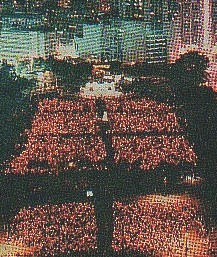
Holding flickering candles high against the night, about 30,000 people in Hong Kong defied China's threat to democracy there. They all joined at June 4 night to honor the victims of the 1989 student's democracy movement at the Tiananmen Square for initially merely calling government reforms for Anti-Corruption , Freedom of Speech.
The student movement spread quickly and snowballed to other sectors.
More than a million students, workers, and their allies congregated in Tiananmen Square. They came to talk to their leaders, not to overthrow them.
The government declared martial law. But it was ignored by the students. Chinese government then sent in troops from the suburban areas. The amazing response from the Beijing citizens completely surprised both the Chinese government and the PLO Army. Massive citizens of Beijing flooded outward from the city. They surrounded and blocked all the army vehicles, and successfully prevented the troops from entering the city. The citizens explained to the PLO soldiers of what was going on in the Tiananment and their peaceful movement. After 4 days standoff, the PLO Army retreated.
In fact, the Chinese government was totally paralysed by those who advocated peaceful nogotiation and the hardliners who demanded an army crackdown. Finally, the paramount leader Deng decided to send in army again. This time the troops were drawn from the armies across China, and backed up with tanks and AK47. Most deaths were occurred outside the Tiananment Square on their way in. The Chinese Red Cross initially reported 2,600 killed, then retracted under intense pressure from the government. The official Chinese government figure is 241 dead, including soldiers, and 7,000 wounded.
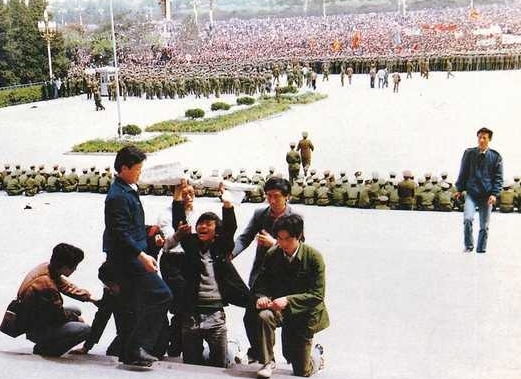
The most powerfully suggestive image of the movement, for many, was not the
lone man in front of the tanks, but the 3 motionless students kneeling on the steps of the Great Hall of the People. This solitary trio had come to supplicate to their leaders who refused to see them.
The crowd clapped and cheered when speakers from the multi-party organizing committee, the Hong Kong Alliance in Support of the Patriotic Democratic Movement in China, called for continued pressure for reform in China and Hong Kong after 1997. Cheung Man Kwong, a spokesperson told the crowd. "The night is long and so is the road. We'll not accept that we are a subversive organization and the Hong Kong people will not accept it either."
Nearly one million people marched through the streets of Hong Kong after the Tiananmen Massacre in Beijing 1989. The crowds dropped sharply in the following years. But this year's crowd appeared larger than the one in 1996, this could be the last such tribute to take place before China takes over the rule of Hong Kong in July 1st, 1997.
Until Tiananmen, Britain's only objective had been to protect its own lucrative relationship with Hong Kong; it had certainly never, in the hundred years of its presence there, considered the establishment of meaningful democratic institutions. The tremendous impact of Tiananmen Massacre forced the British government, for the first time, to consider the future from the point of view of the people of Hong Kong, and not just from the perspective of British trade.
Something had to be done. Christopher Patten, the last governor, whose mandate became to enhance what political freedoms could be institutionalized before the handover. Working within the agreements signed earlier by Britain and China, he had little room to maneuver; but he did manage to establish a democratically elected legislative council, albeit one with a complex and partly indirect voting structures.
Beijing reacted angrily to all his moves and called him the serpent, whore, and "sinner for a thousand years".
First, China's hand-picked preparatory committee in Hong Kong voted 149-1 to immediately abolish Hong Kong's first fully elected legislature after this year's handover and replace it with appointed pro-China legislators and other loyalists. The lone adviser was dismissed. Then more shocking when a senior Chinese officer indicated that Beijing will require proof of loyalty from senior civil servants and a pledge that they will accept the authority of the rubber-stamp legislature.
Immediately, thousands lined up to apply for a British semi-passport, a travel document. The final count of the crush is more than 230,000. almost half of which came in the week before the deadline. The panic and desperateness alarmed Beijing. China answered the frenzied rush for the British travel semi-passport with the consoling words of an advertising campaign. Beijing immediately ran ads in both English and Chinese newspapers inviting Hong Kong's people to phone in with their obvious concerns.
Many pro-China supporters have also secretly prepared for the worst. Mr. Tsang Yok-sing, once a street-fighting Maoist during the Hong Kong's Cultural Revolution riots, now head of Hong Kong's leading pro-China political party and a steadfast supporter of China for 30 years, was waiting in line for medical examinations to clear him for emigration to Canada. He was part of his wife's family application. The story broke out in 1994 just before the election in 1994, causing Mr. Tsang and his party no end of embarrassment. This was clearly NOT an endorsement of Hong Kong's future under Chinese sovereignty by the HK leading pro-China political party leader. Due to public outcry, he had to give up his application.
Many people said they came out not just to honor those slain in Beijing but to demand that Hong Kong's freedoms remain untouched. "This is a test thermometer of human rights in Hong Kong after 1997," said Martin Lee. "If we cannot hold it in the future, then we can no longer see Hong Kong as "One Country, Two Systems". It is China's promise for Hong Kong which will also be served as a solution for Taiwan under "One Country, Three Systems".
In October 1996, the Chinese foreign minister Qian Qi-shen told the Asian Wall Street journal that Hong Kong activists would not be able to mark the 1989 Tiananmen Square Massacre. He was responding to a question about whether China would permit commemorations to continue after the British colony is handed over to China.
This had immediately triggered series of protests from Hong Kong people. "Of course we will continue commemoration." said Cheung Man-kwong, a leader of the Hong Kong Alliance in Support of Patriot Democratic Movements in China, "Commemoration is not illegal under Hong Kong's law. China cannot just single out on the law book that the June 4 commemoration is illegal, while allowing patriotic activities to be held in Hong Kong, such as fund-raising galas for victims of flood in southern China."
Then, Chinese foreign ministry spokesman Shen Guofang explained that Mr. Qian's remarks had been "wrongly extended" and marked no shift in Chinese policy on post handover Hong Kong. "Hong Kong people will have full freedom of expression, but all freedoms must be within the limits allowed by law," Shen said.
In October 1996, the Chinese government forced a group of Hong Kong politicians flying into China to return to Hong Kong before they could deliver a 60,000 signatures petition opposing Beijing's plans to scrap Hong Kong elected bodies and replace them with appointed councils.
In October 1996, Wang Dan who was a prominent student leader of the 1989-democracy movement and was later jailed for 3 and half years. He was again formally charged after 17 months detention. Wang Dan was detained May 21, 1995 after signing a petition calling for reform in 1995. He was again sentenced to another 11 years for conspiring to subvert the government.
Chen Ziming, accused by the government as a "black hand behind the black hands" at Tiananmen Square, was originally sentenced to 13 years. He was paroled in May 1994 on medical grounds but was reimprisoned on June 25, 1995. Diagnosed with testicular cancer, he was "released" on medical parole on November 6, 1996 but effectively became a prisoner in his own home.
Other activists on the mainland have also been recently sentenced to re-education through labor and charged with subversion.
On December 11 1996, the handpicked committee, as expected, had decided Tung Chee-hwa to be Hong Kong's first post-colonial chief executive.
Tung's family company was on the verge of bankruptcy during the oil crisis of 1980's. Part of the successful rescue plan involved Beijing backing for the $120 million syndicate investment made by Henry Fok in return for 8 % of the shares in the trouble firm when Tung could not get any financial support from Taipei, leaving many critics to speculate that Mr. Tung is on the hook to Beijing for the past financial support.
"We sincerely hope that Mr. Tung can now prove to the Hong Kong people and the world that he is better than the un-representative system that produced him. What Hong Kong needs now is not a spokesman for China, but an uncompromising defender of the Hong Kong's freedoms and way of life." said Matin Lee.
On December 21 1996, the same China hand-picked committee that chose Mr. Tung had also chosen 60 members of a new provisional legislature that will replace the current elected assembly the moment British rule ends at midnight on July 30. China's decision to scrap the existing legislative council is on the ground that it was elected under unilateral democratic reforms pushed by governor Patten. New election will be called in the spring of year 1998 with new election rules. Both Bar Association and the Law Society have made clear that there is no legal basis for China's action.
Big controversy was also caused by the recommendation of the legal sub-group of the Preparatory Committee. Among the recommendations are an end to the legal supremacy of Hong Kong's bill of rights over other statutes, restoring the right of police to ban demonstrations and prohibiting political group from having ties with foreign organizations after July 1.
In the midst of escalating furor over these Beijing-backed proposals, Mr. Xi Yang, working for Hong Kong Ming Pao newspaper, was suddenly released on parole after serving 3 years of a 12-year prison sentence for allegedly stealing state secrets. He was arrested in 1993 after writing stories on China's interest rate policy and plans to sell gold on the international market. His release is seen by most observers as Beijing's effort to ease the current public furor.
On Feb. 1 1997, the Preparatory Committee (PC) adopted its legal subgroup's motion and asked the National People's Congress standing committee to declare when the Hong Kong SAR comes into being that the above mentioned 24 Hong Kong ordinances will in whole or in part cease to be in force. However, due to public pressure, the PC made it clear that it no longer insists on reinstating the repealed old colonial ordinances. It will be up to the future SAR to decide how to fill in the lacuna.
In the early 1970s, Hong Kong's colonial administration created an independent agency to target the most hated corruption, extended its authority to business as well as the public sector. The Independent Commission Against Corruption ICAC now is one of Hong Kong's most respected agencies. It has virtually demolished all syndicated corruption in Hong Kong.
The Anti-Corruption was initially the most significant major triggering factor of the 1989 Student Democracy Movement at the Tiananmen Square, and was one of their key demands. 23 years after the massacre that shocked the world, Corruption has become China's worst nightmare - Out of Control. In 2012, China's PM says corruption still the biggest danger to party. It becomes so rampant that finally in 2012, Xi Jinping, Chinese President launched an unprecedented Anti-Corruption campaign targeting Party, government, military and state-owned company officials 1 . 2 . 3 . and . 'One million' Chinese officials punished for corruption.
Hong Kong people are now really concerned about there might be corruption spillover into Hong Kong after July 1st. The authorities in neighboring Guangdong province have now turned increasingly to the ICAC for assistance in battling graft across the border to combat a wave of cross-border crime.
In May 1997, municipal officials had prohibited a sculpture called Pillar of Shame depicting about 50 painfully twisted bodies piled in a heap, from being exhibited during the summer in various Hong Kong parks because of the negative reaction from Beijing. The sculpture will be unveiled at the candlelight vigil on June 4 night.
Just barely one month before China could scrape the Hong Kong's elected legislative council, the council officially passed a historic motion to restore the justification of the student Democracy Movement in 1989. The voting result : 29 to 1. There were 25 legislators absent in the voting.
"No one really wanted June 4 to happen," Mr. Tung Chee-Hwa told reporter. "But over the past 8 years, some people have continued to persist on the issue of June 4. Perhaps they should look forward." "Why doesn't he ask the people of Hong Kong to forget the Opium War ?" said activist Hon Donfang, "That was also the past."
On June 4 night 1997, approx. 50,000 people turned out for the annual vigil. Of all the activities in Hong Kong, the biggest one is still the June 4 commemoration. It clearly reminds Beijing that Hong Kong people want more than merely a desire to make money. It could be the last time in HK. After July 1, permission will be required. "In theory, the decision will be made by Tung Chee-Hwa. In reality, it will be up to Beijing." said Martin Lee.
A recent poll in June has indicated that more people were satisfied with the performance of the last colonial governor Pattern than Mr. Tung was. As for the non-elected provisional legislature received a dismay rating of only 7 % which clearly underlines it has no legitimacy among HK people. "If Beijing in the past 40 years had governed China better than Hong Kong, then no one in HK will oppose the handover." said one citizen.
July 1st, 1997 is definitely a historic Happy Day for ALL Chinese - the return of Sovereignty of Hong Kong to the motherland China.
At last, at midnight June 30 1997, for the 68th time this century, the Union Jack was slowly slided permanently down the colonial flagpole in HK. At one minute after the midnight on July 1st, China's flag rose in HK. President Jiang Zemin declared that a historic wrong has been righted and HK is coming home. The five-day celebration began.
Britain's last major colony HK was formally transformed into the wealthiest, most advanced, free and democratic city in the whole China.
In his journal of the handover, at which Prince Charles represented his mother Queen Elizabeth II, heir-to-the-throne
Charles called the handover as "The Great Chinese Takeaway" without mentioning one word about the destructive British Opium. Ironically, he accused the rightful owner retrieving the loot as the robber.
On July 1st 1997, the first day after handover, with the China's top leaders still in town, about 3,000 HK people marched through HK demanding an end to one-party ruling in China. This was the first peaceful demonstration after the handover. Police made no effort to halt the march. "It is a very positive sign that we could do today what we have done in the past," praised the organizer.
On July 8, 1997 one week after the handover, the appointed HK government introduced proportional representation for the lone 20 out of 60 seats to be decided by universal suffrage. The revised voting system is designed to reduce the democracy parties with the most popular support to minority in next year's legislature election. Martin Lee called the amendments "a farcical distortion of the purpose of elections, which is to represent the public will."
Senior Prosecutions Division official, having studied the ICAC's report, agreed that newspaper publisher Ms Aw and three executives of the Hong Kong Standard should be prosecuted for conspiring with Ms Aw to defraud advertisers by inflating circulation figures. The Director of Public Prosecutions concurred. However, the Secretary for Justice did not agree and had decided not to prosecute Ms Aw who sits on the National People's Congress and the Chinese People’s Political Consultative Conference. Public outcry has intensified and many worried that the law won't apply to people who have connection with Beijing.
On May 24, 1998 Defying downpour torrential rain, HK voters turned out in record numbers backing the pro-democracy candidates who were ousted by Beijing after the handover in the first election ever held in mainland China. "This is a tremendous vote for democracy from HK people" said Martin Lee. Total 17 seats are now belonging to the pro-democracy parties, which are still a minority in the 60-seat legislature. They were kicked out un-democratically by Beijing last July, but HK voters simply sweep them back in again democratically.
This was indeed an historic event in Chinese history, the democrats and their allies now became the first official opposition party in Communist China.
According to the basic law, only 24 seats will be directly elected by 2000, then 30 seats in year 2004. The whole issue will then be revisited in 2007 to decide how to best achieve all 60 seats to be directly elected.
On June 4, 1998 Undeterred by thunder, lightning and torrential downpour, approx. 40,000 HK residents gathered for a moving candlelight vigil to celebrate and mourn 1989 democracy movement that ended with a brutal, bloody military massacre. "Now that we are part of China, we have to continue to speak out. It's even more important."
The sculpture called The pillar of Shame stood tall in the center of Victoria Park and nearby was a large cut-out wall of the renowned Goddess of democracy to signify that democracy is still a hollow dream as prisoner inside the stone wall. "It is a special day for Chinese. And this year is more special than others." "We'll keep coming back until we see democracy in China." "The person who said that it is time to put behind the baggage of Tiananmen was wrong. Just see how many people showed up tonight." "Hong Kong is in the vanguard of the struggle for democracy in China. It is an embryo of democracy for the whole China."
Feb. 1999 After the Standard trial ended, in which the 3 accused were found guilty and given jail terms of few months, the Secretary for Justice Elsie Leung has finally unravelled the mystery for not prosecuting Sally Aw to the legislators. She said the prosecution of Sally Aw might lead to Sing Tao's business collapse and made more then 1000 citizens jobless, not because Aw has connection with the Beijing government. Her logics were unheard of which are unjustifably favourable to the wealthy employers and is at odds with the principle of "equality before the law". Many has called for her resignation. However, the no confidence motion was defeated.
Jan. 1999 In a two-hour ruling, Chief Justice Andrew Li Kwok-nang said: "These rights and duties are expressed as constitutional guarantees for freedoms which are of the essence of Hong Kong's civil society." He said the freedoms, including the right of abode, lay "at the heart of Hong Kong's separate system" and the court should give a generous interpretation to them. This led the court to rule that the right of abode given to the children of permanent residents by the Basic Law could not be restricted. The ruling awarded right of abode to illegitimate children of Hong Kong residents and to children born before one of their parents became a permanent resident.
The unanimous Court of Final Appeal ruling gave SAR courts the power to interfere with decisions of the National People's Congress which broke the Basic Law, placed restrictions on the circumstances in which cases could be considered by the mainland body and ensured the importance of human rights would be paramount when considering the Basic Law. SAR has repeatedly said it respects it and is prepare to implement it.
In an unprecedented challenge to the Judiciary, Zhao Qizheng, head of the State Council's information office, said Beijing backed criticism made by mainland experts on Saturday. China had accused the court of overriding the power of the National People's Congress (NPC) Standing Committee and said its ruling last month had contravened the Basic Law. "We must support the Basic Law; the Basic Law cannot be changed. The court decision should be changed," said Mr Zhao.
The Law Society expressed concern and said it fully supported the unanimous judgment of the court, which was important in giving an undertaking of the principles of "one country, two systems". Both the rule of law and judicial independence, which have been ingredients of Hong Kong's stability and prosperity. Democratic Party chairman Martin Lee said "the whole of Hong Kong must stand together" if the National People's Congress Standing Committee tried to overrule the judgment. "If we don't get it right and cannot persuade them to abort what they may be doing by getting the NPC to re-interpret the Basic Law so as to overturn the decision, that's the most serious breach of the Joint Declaration and the Basic Law," he said.
In the middle of crisis, the SAR government finally decided to request the Court of Final Appeal (CFA) to clarify. This move was unprecedented in the history of HK's judiciary. CFA then made it clear that in its right of abode judgement it did not call into question the power of the standing committee of the NPC. Critics said this set a dangerous parecedent of allowing the judicial work to be politically influenced and may undermine the citizen's confidence in the independence of HK's judiciary.
June 4, 1999 Approx. 50,000 people came out to mark the 10th anniversary of the June 4th Tiananment Massacre.
....................................................................................
....................................................................................
....................................................................................
On July 1st, 1997 the very first day of the returning of Hong Kong to the motherland China, a Chinese poet wrote in his poem: "The Opium War has truly ended today !". In the opposite, even before the handover, the Fortune magazine had already announced "Hong Kong is dead" as its cover story.
Today, China is no longer the irrational self-destructive China during Mao's disastrous misrule. Democracy is now being practiced at the village level, and still needs a lot of improvements. Media is also allowed to criticize the government to a certain degree.
However, one must remember that although the democracy indeed has its universal value, but the "FORMS of democracy" in the West DO NOT have the universal value. Furthermore, ALL the democratic systems in the West, WITHOUT exception, were implemented gradually and progressively, and ONLY implemented AFTER the country had achieved its modernization.
It was NOT until Martin Luther King, then the 1965 voting rights that U.S. had outlawed various previously legal strategies to prevent the black-Americans, descendants of U.S. African slaves, and other minorities from voting in the U.S.
Ironically, those in the West who obsess about "democracy", rarely – if ever – examine the dearth of " Democracy at the Global Level " – e.g. the U.N. Security Council ( where Africans do not have a permanent seat and Asians are under-represented ) , or the World Bank ( where US nationals rule ) , or the International Monetary Fund ( the bailiwick of Western Europeans ).
A CIA report by US arms inspector of Iraq Survey Group in 1,000 pages concluded U.S. "Almost All Wrong" on Iraq's WMD Weapons. In 2005, after 2 years intensive search with 1,200 experts, U.S. finally quit the WMD search. Unfortunately, the WMD was the main reason for US to "pre-emptive" invade Iraq.
End to search for WMD seals doubts about pre-emption. Later a new presidential commission reported, "We conclude that the intelligence community was dead wrong in almost ALL of its prewar judgments about Iraq's WMD".
U.S. has a long history of initiating wars based on lies in the past 200 years . 2 . 3 under the same cover of "Human Rights" and "Democracy". Its most recent one : Lies to brainwash into a brutal Iraq War . 2 to influence and control oil and Middle-East, and indirectly indirectly created the ISIS Islamic State. DU is a chemically toxic and radioactive. US pressured WHO (World Health Organisation) to cover up US's DU nuclear nightmare in Iraq . 2.
Documentary : The War you don't see . . We steal secrets . . the Power Of Nightmares . . . More than 13 years after the war, Iraq remains in chaos, 'I toppled Saddam's statue, now I want him back' . . . US supplied cash, weapons & tanks to Al-Qaeda . . . Story about Free Tibet.
The democratization in the developing and 3rd world countries, when mishandled often give rise to war, NOT peace. The link between democratization and war has been widely in evidence since the Cold War, and the fundamental pattern is as old as democracy itself, going back at least to the French Revolution. For details, refer to Electing to Fight: Why emerging democracies go to War . Chapter 1 and excerpts from chapters 7 and 8.
The key questions are NOT about whether any country will become a democracy, but rather how to get there, to what degree, and in what FORM.
Therefore, democracy should best be introduced gradually and progressively, according to the unique cultural and modernization conditions of the society.
Whether Hong Kong, "The Pearl of the Orient", will continue to shine brilliantly and finally be fully integrated into its motherland under "One Country, One System" solely depends how wisely China will continue its long overdue Fifth Modernization - the Political Modernization --
Democracy and Freedom with unique Chinese Characteristics.
China now leads the world in the number of Internet users. In 2010, China had 63 million microbloggers out of 457 million Internet users. More than 300 million Internet users are microblogging, and cellphone subscribers - more than 600 million people. Chinese netizens have made their voices heard more loudly and their presence better recognized in headline news events over the past years. Chinese democracy is coming from the Chinese people, the free voices on Internet provides new path to democracy in China . More ......
The amazing story of Hong Kong continues .................
Special Reports
New York Times |
Washington Post |
PBS |
Time |
CNN on Hong Kong